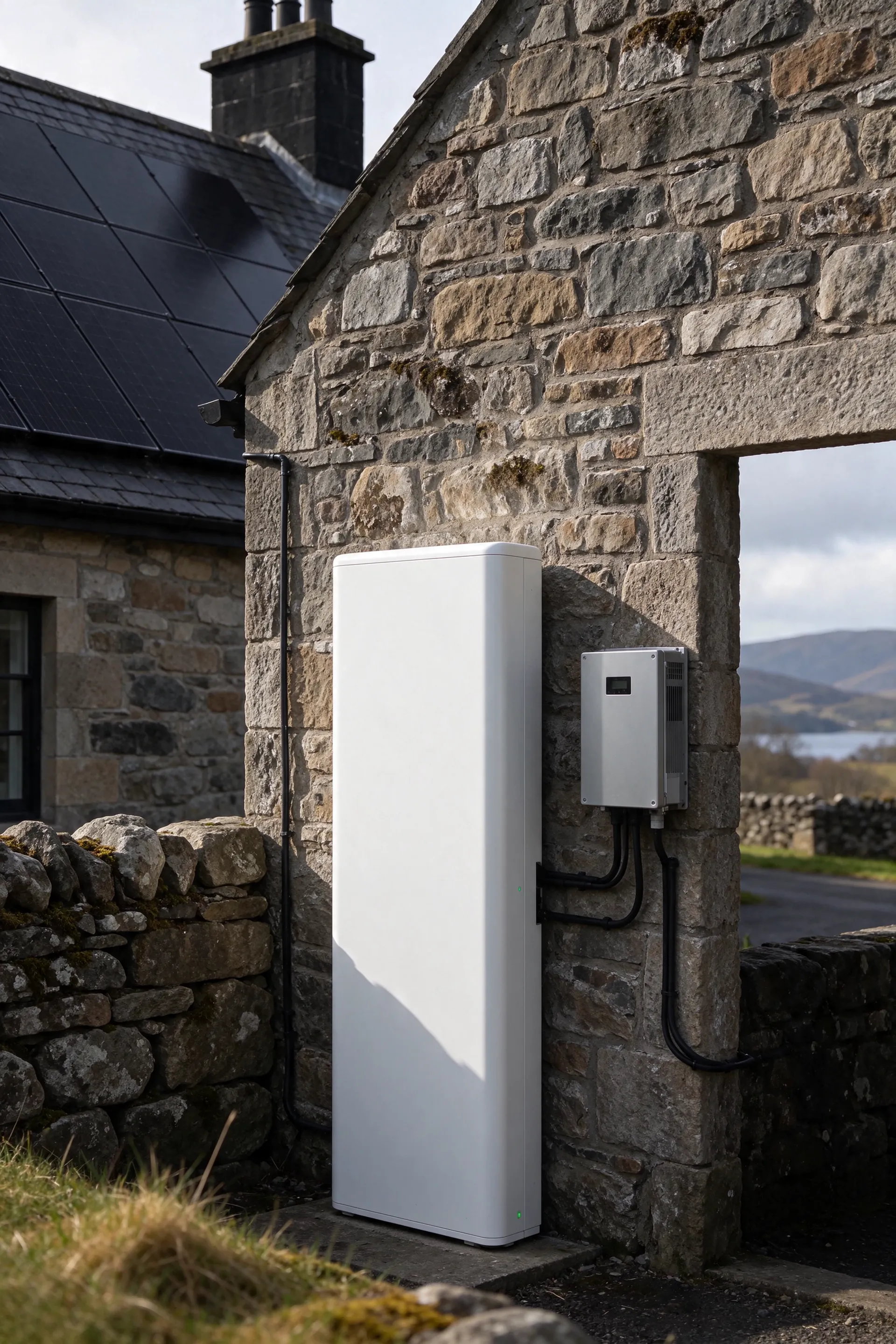
Battery Comparison Scotland 2026
For most Scottish homes upgrading an existing solar system, we recommend the Duracell Dura five. Installed it typically costs between three thousand five hundred and four thousand five hundred pounds. The Tesla Powerwall three costs more, around eight thousand five hundred to ten thousand five hundred pounds, and is better suited to new-build systems with higher demand.
Duracell Dura5 vs Tesla Powerwall 3 — installed costs, warranties, and Scotland availability
Quick answer: For most Scottish homes, the Duracell Dura5 (5.32 kWh, LiFePO₄, 15-year warranty, £3,500–£4,500 installed) is our recommendation. It is AC-coupled, stackable, and installed across Scotland. The Tesla Powerwall 3 offers more capacity but has limited Scottish installer availability. A no-obligation site survey confirms which battery suits your home.
| Feature | Duracell Dura5 | Tesla Powerwall 3 |
|---|---|---|
| Capacity | 5.32kWh | 13.5kWh |
| Installed cost | £3,500–£4,500 | £8,500–£10,500 |
| 0% VAT saving | ~£700 | ~£1,700 |
| Warranty | 15 years | 10 years |
| Chemistry | LiFePO₄ | NMC |
| Scotland install | SEE installs | Limited |
| FiT compatible | ✓ AC coupled | ✓ AC coupled |
| Stackable | ✓ Up to 5 | ✗ No |
Source: typical installed prices from MCS-certified partner quotations, checked 1 November 2026.
Which battery do we recommend for Scottish homes?
The Duracell Dura5 — an AC-coupled, stackable LiFePO₄ battery with a 15-year warranty, installed across Scotland for £3,500–£4,500.
Best for Scotland. Here's why we install more Duracell Dura5 batteries than any other brand:
- 15-year warranty — longest in the market
- LiFePO₄ chemistry — safer, longer life, better in Scottish cold
- Stackable — start small, expand later
- AC-coupled — works with any existing solar system
- We install it through MCS-certified partners — full support across Scotland
Choosing a battery for a Scottish home
Start with usable capacity, measured in kWh. Domestic batteries commonly range from around 5 kWh to around 13.5 kWh, and many can be stacked. A sensible size covers your typical evening and overnight use rather than your whole day. Bigger is not automatically better if the battery rarely empties and refills.
Next, look at power output in kW. This decides how many appliances the battery can run at once. A battery with high capacity but low output may not cover an electric shower, oven and kettle running together, so the grid will top up during busy moments.
AC-coupled or DC-coupled?
An AC-coupled battery has its own inverter and connects on the household side, so it works alongside an existing solar inverter. This is often the simplest retrofit for a Feed-in Tariff system that is working well. A DC-coupled battery connects through a hybrid inverter shared with the panels, which suits homes where the old inverter needs replacing anyway.
Where the battery will live
Most Scottish installs go on a garage wall, in a utility room or under the stairs. Tenement flats often have limited space, while rural homes may use an outbuilding. Check the manufacturer temperature range, the IP rating for damp locations, and the clearances needed around the unit. Lofts are often unsuitable because of temperature swings and access.
Warranty and compatibility
Compare the warranty length and the retained capacity it promises, not just the headline years. Check that the battery works with your inverter and with the tariff you plan to use, and that the installer will register the system and notify your network operator. We install through MCS-certified partners, who confirm compatibility on the survey.
FAQs
Frequently asked questions
Do you install in your part of Scotland?
Yes. We install through MCS-certified partners who cover your part of Scotland and the rest of Scotland. Tell us your postcode and we will confirm availability and arrange a no-obligation survey at a time that suits you.
Can I add a battery to my existing solar panels?
In most cases, yes. A battery can usually be added to an existing solar system, either with a hybrid inverter or a separate AC-coupled battery. A survey checks your inverter, wiring and space before we recommend anything.
Is finance available?
Interest-free credit up to £30,000, subject to status. We will explain the options alongside your written quote so you can decide what suits you.
How do I get a quote?
Call 0141 230 0198 or fill in the quote form. We arrange a survey of your home and system, then send you a written, no-obligation quote.
Keep reading
Related guides

- Battery savings calculatorEnter your own usage and solar size to see which battery size could suit your home.Read guide
- Is battery storage worth it in Scotland?Where the savings come from and where the uncertainty lies.Read guide
- How a battery upgrade worksEvery step from first enquiry and site survey to network notification and switch-on.Read guide
- Guarantees and aftercareWorkmanship, manufacturer and insurance-backed guarantees explained.Read guide